Night Court
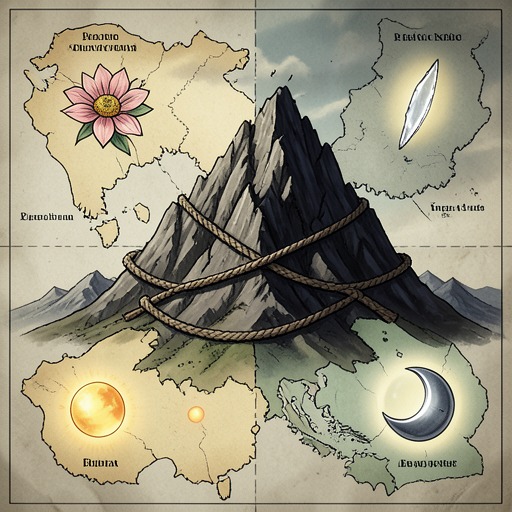
A Court of Thorns and RosesThe Night Court is the northernmost territory of Prythian’s seven courts and the most strongly associated with darkness, starlight, danger, and concealed power. In Feyre Archeron’s first view of the courts, it appears as a vast frozen mountainous region, visually distinct from the warmer or brighter territories below it. Its significance lies not only in its geography but in the fear its name commands: the court is presented as a land of lethal beauty whose unseen inhabitants suggest that magnificence and threat are inseparable.
Geography and First Appearance
The Night Court occupies the uppermost position on the painted map of Prythian, beyond the Autumn Court, Summer Court, Winter Court, Dawn Court, and Day Court. Feyre identifies it as a sprawling territory spread across frozen mountains, darkness, and stars. The map offers no comforting detail that would make the region familiar or manageable. Instead, the court’s landscape appears immense and remote, a place whose beauty is inseparable from its hostility.
The image is made more unsettling by the things Feyre perceives moving in the shadows between the mountains: small eyes and gleaming teeth. These details transform the court from a merely distant political territory into a living threat. Its darkness does not signify emptiness. It conceals beings capable of watching, hunting, and waiting beyond the limits of mortal knowledge. The Night Court therefore enters the narrative as an example of the sublime: a space beautiful enough to attract attention, yet too vast and dangerous to be safely understood.
The Court as a Mortal Fear
For mortals living beside the Wall, the Night Court belongs to the world of inherited warnings about the faeries. The human territories are too poor to maintain a standing army along the border, leaving villagers dependent on the Treaty forged five hundred years earlier. Hired swords may guard the lands of the wealthy, and iron bracelets or protective charms may offer a temporary illusion of safety, but neither class nor rank can erase the fundamental imbalance between mortals and High Fae.
That fear is rooted in history. Before the Treaty, mortals had been enslaved by High Fae overlords and forced to build their civilizations, temples, and monuments. The War eventually ended through the intervention of six mortal queens, who negotiated the Treaty and helped construct the Wall dividing the human and faerie realms. The North was conceded to the High Fae and faeries, while mortals were confined to the South, where they survived by working the earth. Against that background, the Night Court’s position beyond the Wall is not simply scenic. It belongs to the larger geography of dispossession, memory, and an old political order in which human safety depends on boundaries created after catastrophic violence.
Association with Power and Punishment
The Night Court’s name becomes directly legible when Lucien Vanserra discovers a sigil branded behind the ear of an unidentified male head displayed in a pool of red water. The mark is a mountain with three stars, and Tamlin recognizes it as the sign of the Night Court. The discovery produces immediate uncertainty: neither Tamlin nor Lucien recognizes the victim, and the brand suggests that the court’s authority or reputation has reached beyond its visible territory.
The scene also establishes the court as a symbol that can be used to identify, mark, or threaten a body. Its emblem does not explain the dead figure’s identity, but it turns the Night Court into an accusation and a source of dread. The mountain and stars that had seemed remote and almost painterly on the mural become a physical sign attached to violence. The shift from map to branded flesh gives the court a material presence before Feyre has any fuller knowledge of its society.
Relations with the Wider Political Order
The Night Court is one of the seven courts whose territories were weakened and subordinated during Amarantha’s conquest of Prythian. Amarantha came from Hybern as an emissary, presented herself as a reforming courtier, and spent fifty years cultivating the trust of the High Lords. She used trade and diplomacy as intermediaries for military infiltration, bringing personal forces into Prythian through the same ships that carried Hybernian goods. When the High Lords gathered at a ball in her honor, she poisoned their wine with a potion stolen from the King of Hybern’s spell book and removed much of their power from within their bodies.
The Night Court is therefore part of a political system whose apparent separateness did not protect it from imperial manipulation. After the High Lords fell, Amarantha gathered the most vicious beings in Prythian, including creatures considered too terrible even for the Night Court, by offering them sanctuary. Her rule depended on both conquest and incorporation: she weakened established authorities, absorbed dangerous outcasts, and built an army for a future assault on the human territories. The court’s reputation for darkness thus contrasts with Amarantha’s broader strategy of assembling power from across Prythian and Hybern.
Presence in the Ending
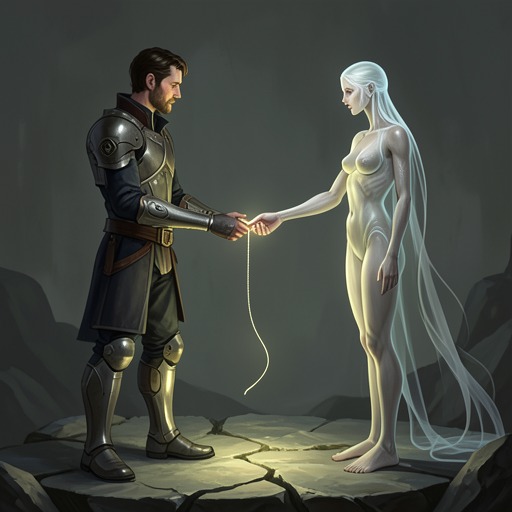
Although the Night Court begins as a distant, ominous region and later appears through a mark associated with violence, its final significance becomes more complicated after Amarantha’s defeat. When Feyre Archeron is restored, the High Lords each contribute a drop of light to the fragment of soul that remains with her. Rhysand steps forward on behalf of the Night Court and gives his own gift, saying that what Feyre gave has earned an extraordinary recompense and declaring that the exchange makes them even.
This act changes the court’s symbolic position. The Night Court is no longer represented only by darkness, hidden eyes, lethal mountains, or a threatening sigil. Through Rhysand, it participates in the collective restoration of Feyre’s life and in the recognition of her sacrifice. Its darkness remains part of its identity, but the ending refuses to leave that darkness as a simple synonym for evil. The court becomes a counterpoint to the fear that shaped Feyre’s mortal understanding of Prythian: a place associated with danger and secrecy that nevertheless contributes light when the old political order is being remade.